
Aluminum vs Stainless Steel Heated Towel Rails: Which Is Better?
Aluminum heated towel rails are a strong choice when low weight, effective heat distribution and flexible product design matter. Stainless steel is attractive when a brushed or polished metal finish and a robust construction are priorities. Neither material automatically guarantees lower electricity bills or faster towel drying: the complete product design matters more than the material name alone.
This guide compares aluminum—also spelled aluminium—and stainless steel for electric heated towel rails, helping homeowners, retailers and private-label buyers choose the right specification. Water-filled central-heating rails involve additional factors, including the heating system and water chemistry.
Aluminum vs Stainless Steel: At a Glance
| Buying consideration | Aluminum heated towel rails | Stainless steel heated towel rails |
|---|---|---|
| Heat conduction | Higher material thermal conductivity; useful for spreading heat through the rail | Lower material thermal conductivity; heater layout and construction remain important |
| Weight | Lower material density; can support lightweight designs | Higher material density; compare the finished product’s actual weight |
| Warm-up time | Can support a responsive design; verify model-specific results | Depends on mass, heater power and construction—not simply the metal |
| Electricity use | Determined by power draw, operating time and controls | Determined by the same factors |
| Corrosion | Alloy, finish, environment and care all matter | Grade, finish, fabrication, environment and care all matter |
| Appearance | Suitable for anodized or coated finishes, depending on the product | Suitable for brushed or polished metal finishes; coated options also exist |
| Purchase decision | Compare the complete specification and landed cost | Compare the complete specification and landed cost |
These are material-level distinctions, not results from a matched test of two towel rails.
Request pricing, MOQ and OEM/ODM options →
PARTNER WITH EVIA →
LinkedIn →
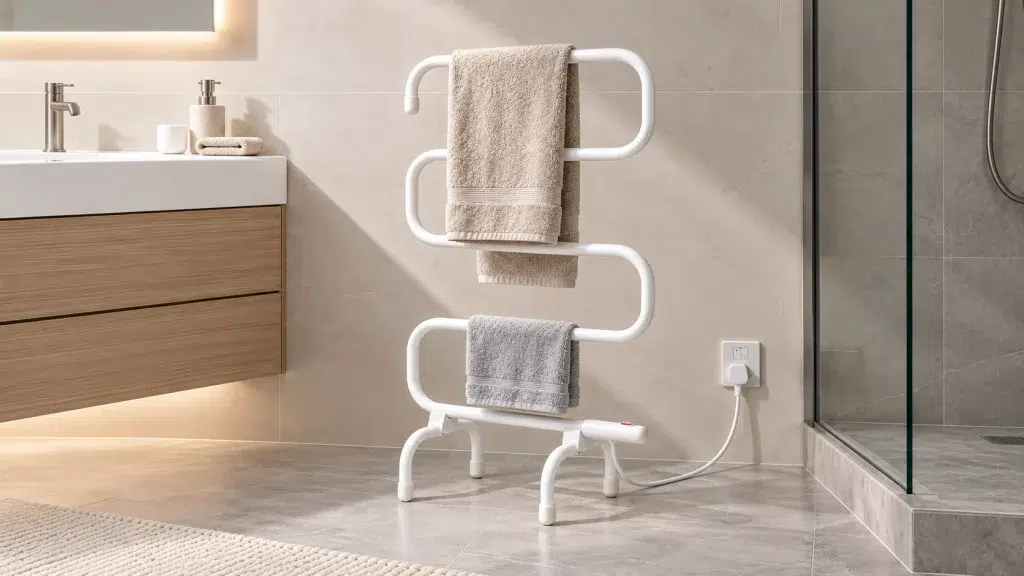
Which Material Distributes Heat Better?
Aluminum conducts heat more readily than common austenitic stainless steels. As an illustrative comparison, Aalco lists thermal conductivity of 201 W/m·K for 6063-T6 aluminum and 16.2 W/m·K for 304 stainless steel. These reference grades demonstrate the material difference; they do not identify the alloy used in any particular EVIA model. Sources: 6063-T6 aluminum properties and 304 stainless steel properties.
For a heated towel rail, higher conductivity can help heat spread away from the heating element. However, the element’s position, its contact with the metal, the tube geometry and the temperature control also affect surface temperatures.
Do not interpret the conductivity difference as a claim that aluminum dries towels twelve times faster. Towel thickness, moisture content, room humidity, airflow and contact with the bars all affect drying time. For a meaningful comparison, test both products with the same towels under the same conditions.
Does Aluminum Heat Up Faster?
An aluminum rail can be designed for a quick response, but warm-up time is a property of the complete appliance. A lightweight dry-element rail and a heavier fluid-filled rail may behave differently even when their outer materials are identical.
Ask what “heated up” means in the supplier’s test: a warm surface, a defined temperature at a particular point, or a warmed towel. These are different outcomes.
For retail product pages, use a model-specific warm-up claim supported by a stated test method. For sourcing decisions, request a temperature curve and surface-temperature measurements rather than relying on a general “fast heating” label.
Which Heated Towel Rail Uses Less Electricity?
Aluminum does not automatically use less electricity than stainless steel. At the same actual power draw and operating time, two electric rails consume the same amount of electrical energy, regardless of their outer material.
For continuous operation at rated power:
Energy use (kWh) = power (W) ÷ 1,000 × operating hours
For example, a 200 W towel rail operating continuously at full power for two hours uses:
200 ÷ 1,000 × 2 = 0.4 kWh
Multiply 0.4 kWh by your electricity tariff to estimate the energy charge. This is a calculation example, not a measured EVIA consumption test. Thermostatic cycling may reduce heater on-time; actual consumption depends on the controller, settings and conditions.
A timer can help avoid unnecessary operating hours. A lower-wattage rail is not automatically the better choice if it provides insufficient drying space or needs a longer cycle for the intended load. Compare energy used to achieve the same drying result, not just the wattage printed on the label.
Which Material Resists Corrosion Better?
Both materials can be suitable for bathroom products, but neither should be described as corrosion-proof in every environment.
With aluminum, evaluate the specified alloy, surface treatment and coating quality. Aalco identifies good corrosion resistance and suitability for anodizing among the properties of its reference 6063 alloy. That does not establish the performance of every finished aluminum towel rail.
Stainless steel depends on a protective passive surface film. Its corrosion performance varies with composition, surface finish, fabrication, contamination and maintenance. Chloride exposure and aggressive cleaning conditions require particular attention. Outokumpu’s guide to stainless steel corrosion resistance explains these factors.
For either material, follow the manufacturer’s cleaning instructions and confirm suitability for the actual installation environment. For coastal properties or demanding hospitality applications, ask for the material specification, care requirements and relevant test evidence rather than accepting “rustproof” as a complete answer.
Weight, Mounting and Bathroom Layout
Aluminum’s lower density is useful where product handling and mounting weight matter. The reference material densities are approximately 2.70 g/cm³ for 6063 aluminum and 8.00 g/cm³ for 304 stainless steel, according to the Aalco datasheets linked above.
This does not mean a finished aluminum rail always weighs one-third as much as a stainless steel model. Tube thickness, dimensions, brackets, controls and any internal fluid all contribute to appliance weight.
Compare the finished net weight, bracket design, approved mounting method and supported load. A lightweight product still needs the correct fixings for the wall and must be installed according to its instructions.
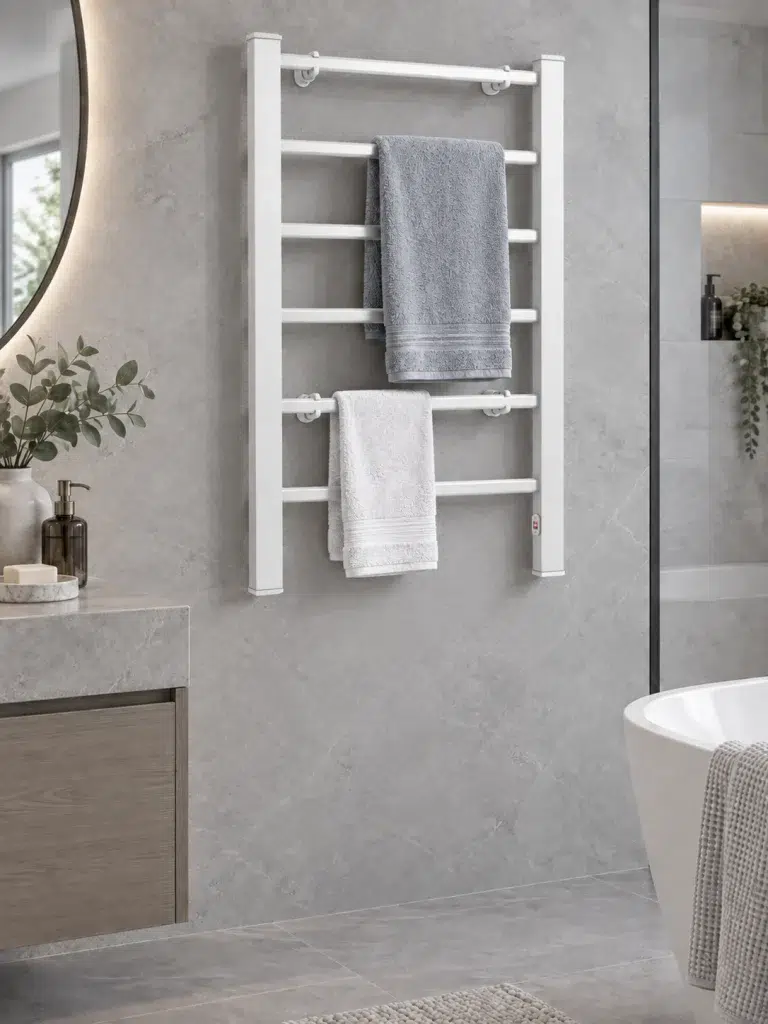
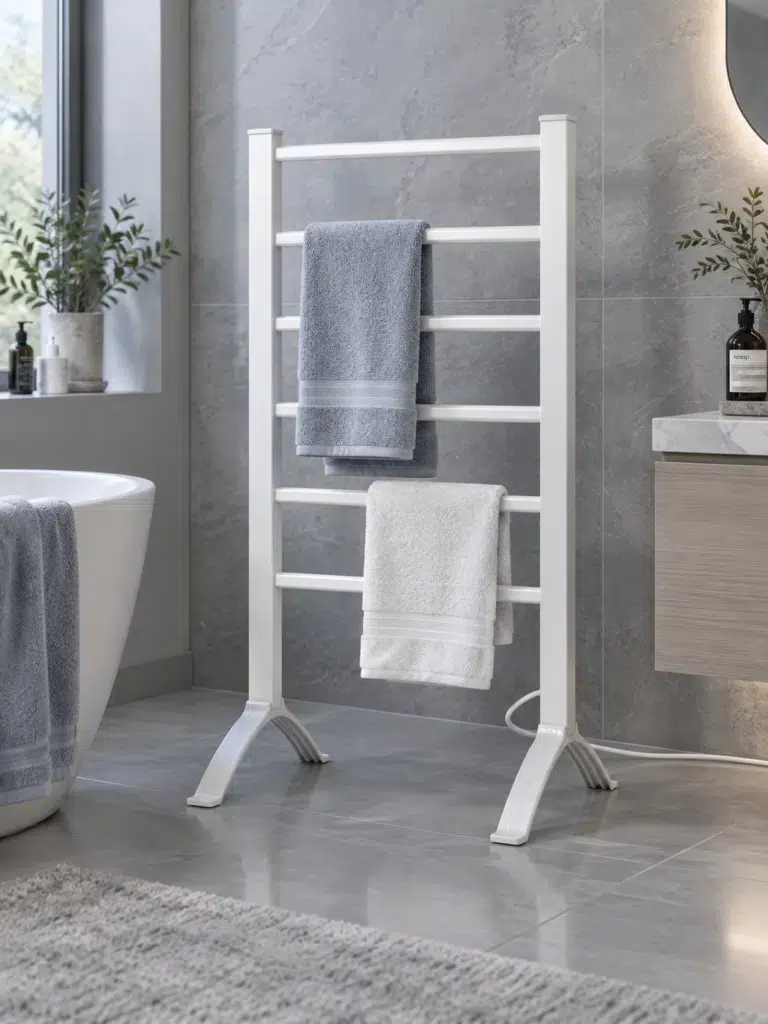
EVIA EV-100 shown in wall-mounted and freestanding configurations. Select the mounting arrangement and accessories specified for the supplied version.
The EVIA catalog lists the EV-100 as a 100 W aluminum model with six heating tubes and both wall-mounted and freestanding configurations. This illustrates why mounting flexibility can be more useful to a buyer than the material comparison alone.
Request pricing, MOQ and OEM/ODM options →
PARTNER WITH EVIA →
LinkedIn →
Appearance, Maintenance and Product Cost
Stainless steel is worth considering when an exposed brushed or polished metal appearance is central to the bathroom design. Aluminum can suit collections built around coated colors or anodized finishes. Check actual finish samples: a silver-colored rail is not necessarily stainless steel, and a black rail’s appearance does not reveal its underlying material.
For both options, consider how the surface looks after routine cleaning, how accessible the gaps between bars are, and whether replacement controls or mounting parts are available.
For B2B buyers, compare quotations on an equivalent basis. Specify dimensions, heating area, controls, packaging, order quantity and delivery terms. Material weight can affect handling and shipping, but carton volume, packaging design and freight terms also influence landed cost. Neither material is universally the cheaper finished product.
What Retailers and OEM Buyers Should Check
Before choosing a towel rail range, request these details for the exact model and configuration:
- Material and finish: declared alloy or stainless grade, surface treatment and finish samples.
- Heating performance: rated power, warm-up test conditions, temperature distribution and towel-drying results.
- Controls: included timer or thermostat functions, and which options require a different version.
- Installation: dimensions, weight, approved mounting hardware and electrical connection requirements.
- Product documentation: applicable market documentation and evidence tied to the supplied configuration.
- Commercial support: packaging specifications, spare parts, warranty terms and sample availability.
Material selection alone does not establish electrical safety or bathroom installation suitability. Check the product instructions and the requirements of the destination market with the appropriate installer or compliance specialist.
For a wider selection checklist, read our electric towel warmer buying guide. If you are comparing product categories, our guide to heated towel rails vs towel warmers explains the terminology.
EVIA Aluminum Heated Towel Rail Examples
EVIA’s 2026 catalog includes aluminum models for different layouts and product ranges:
| Model | Rated power | Heating tubes | Configuration shown in the catalog |
|---|---|---|---|
| EV-100 | 100 W | 6 | Wall-mounted or freestanding |
| EV-190 | 190 W | 10 | Wall-mounted, flat bars |
| EV-200-2 | 200 W | 20 | Wall-mounted, oval bars |
These are catalog specifications, not comparative performance results. Confirm current dimensions, finishes, controls and market-specific configurations before ordering. A control panel shown in a catalog image should not be taken to mean every listed function is included in every version.
Explore EVIA’s aluminum electric towel warmers to discuss suitable models for your range.
Which Material Should You Choose?
Choose aluminum when low weight, heat distribution and a flexible range of product designs are priorities. Choose stainless steel when the specified stainless finish, construction and material grade are important to your project.
For either option, make the final decision using model-level evidence: usable towel space, temperature behavior, energy consumption for the intended routine, finish quality and installation requirements. The best heated towel rail is the one that fits the application and delivers documented performance.
Planning an aluminum towel warmer range? Contact EVIA for product specifications and an OEM/ODM discussion. Share your target market, preferred mounting style, finish, controls and estimated order quantity so the team can help you evaluate suitable options.
Frequently Asked Questions
Is aluminium the same as aluminum?
Yes. Aluminium is the usual British English spelling, while aluminum is the American English spelling. They refer to the same metal.
Are aluminum heated towel rails cheaper to run?
Not simply because they are aluminum. Running cost depends on actual power consumption, operating time and electricity price. Compare matched drying tasks and controller settings for a useful assessment.
Can stainless steel heated towel rails corrode?
Yes. Stainless steel resists corrosion but is not immune to it. The grade, finish, environment and cleaning practices affect performance.
Does a hotter towel rail always dry towels faster?
Temperature is only one factor. Towel contact, spacing, airflow, moisture content and room humidity also matter. Use the appliance within its specified operating conditions.
Is a towel rail a replacement for bathroom heating?
Do not assume so. A towel-warming appliance may provide incidental room heat without meeting the bathroom’s heating requirement. Check the intended use and documented output of the specific model.