
How to Choose a Heated Towel Rail Manufacturer for OEM and Private Label Projects
Choosing a heated towel rail manufacturer means evaluating more than a product photo and a unit price. For retailers, importers and private-label brands, the right partner must connect your market requirements with a defined product specification, supporting documentation and repeatable production.
Quick answer: Choose a manufacturer that can demonstrate relevant product experience, provide documentation for the exact configuration, agree a controlled reference sample and explain how production changes are managed. Compare quotations using the same specifications, packaging, testing scope and delivery terms before committing to an order.
This guide focuses on electric rail-style towel warmers for OEM and private-label projects. Hydronic radiators and enclosed towel-warming cabinets require different product assessments.
Already planning a range? Explore EVIA’s electric towel warmers to identify the product format you want to discuss.
1. Define Your Project Before Comparing Manufacturers
A useful enquiry starts with the destination market and intended sales channel. A bathroom retailer, an appliance distributor and a hotel project buyer may need different installation arrangements, packaging and support.
Prepare a short brief covering:
- Destination country and sales channel.
- Expected initial order and potential repeat demand.
- Wall-mounted, freestanding or supported convertible format.
- Preferred dimensions, material, finish and towel capacity.
- Voltage, frequency and electrical connection requirements.
- Required on/off, timer or temperature-control functions.
- Branding, packaging language and installation accessories.
- Target launch date and sample requirements.
Keep mounting style and electrical connection as separate decisions. A wall-mounted towel rail is not automatically hardwired. Our plug-in vs hardwired heated towel rail guide explains the distinction.
If some details remain open, identify them as questions for the manufacturer. An incomplete but transparent brief is more useful than an assumed specification that changes after quotation.
2. Clarify OEM, ODM and Private-Label Scope
Suppliers do not always use these terms consistently. Ask what each service includes in the quotation and development agreement.
| Project route | Typical scope | What to clarify |
|---|---|---|
| Private label on an existing model | Your brand, approved labels, packaging and manuals | Available options, artwork requirements and model-specific documentation |
| OEM to an agreed specification | Manufacturing against defined requirements or buyer-controlled design | Design responsibility, drawings, approved components and change control |
| ODM development | Manufacturer-supported design or adaptation | Development fees, tooling, testing, ownership and exclusivity |
A logo or carton change is a different project from changing the heating system, controller or structure. Ask which requests can use an existing platform and which need engineering review, tooling or additional assessment.
For any new design, document ownership of tooling and drawings, maintenance responsibilities, and the conditions for exclusivity. Do this before paying development charges.
3. Check the Manufacturer’s Evidence, Not Just Its Catalogue
Relevant experience should be visible in the supplier’s explanation of how products are built and controlled.
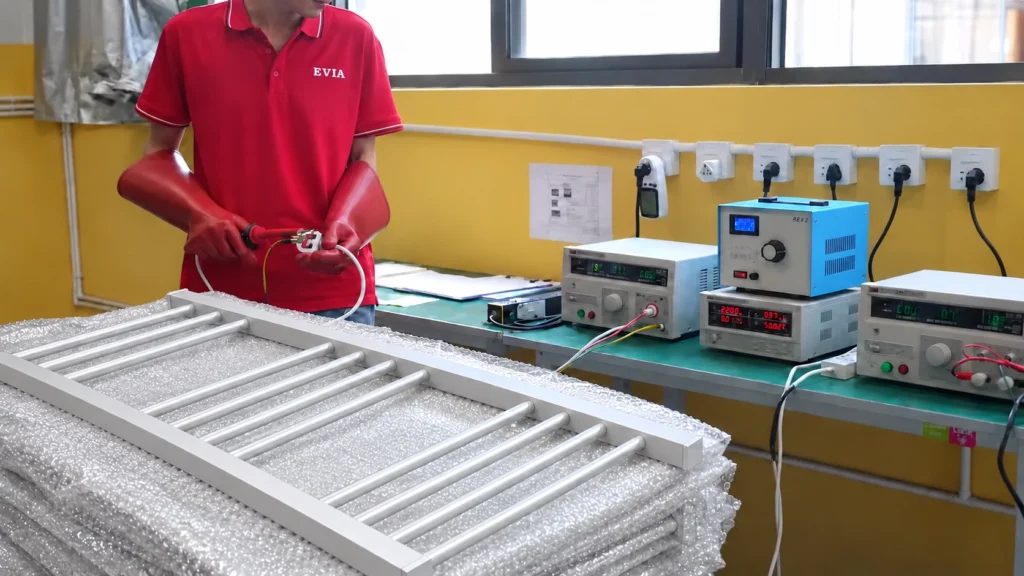
Ask which operations the manufacturer handles in-house and which it outsources.Request a factory review, live walkthrough or suitable independent audit if the project warrants it. Discuss incoming-material checks, heating-system assembly, wiring, surface finishing, functional checks and final packing.
The key question is whether the manufacturer can connect the approved specification to a production batch. Useful evidence includes controlled work instructions, inspection records, component traceability and a process for investigating defects.
Treat factory capacity as a planning input. Ask how much capacity is available for your order during the required production window, rather than assuming total factory output is available to your project.
Review EVIA’s manufacturing background as an introduction, then request evidence relevant to the proposed model and order.
4. Verify Compliance for the Exact Product Configuration
A certificate logo on a website is not enough to approve a private-label towel warmer. Review documents against the model, electrical rating, control system and supplied accessories in your quotation.
Ask the supplier to identify:
- The exact model and variants covered by the documents.
- The manufacturer and applicant named in the records.
- Applicable test reports, declarations and third-party certificates where relevant.
- The scope and status of supporting documents.
- Any additional work required by the proposed modifications.
- Responsibilities for labels, instructions and destination-market documentation.
For the EU, official CE marking guidance explains the manufacturer’s responsibility for conformity. CE marking should not be treated as a generic independent quality award. The EU also explains the role of technical documentation in supporting conformity.
For other destinations, confirm the applicable requirements with a qualified compliance specialist or test laboratory. Do not assume that documentation for one market covers another, or that changing a plug is the only adaptation needed.
Our electric towel warmer safety standards guide provides further questions for supplier discussions. Confirm any bathroom installation limitations in the instructions for the supplied product.
5. Approve a Sample That Represents Production
The sample should match the configuration you intend to sell. Record its model, revision, finish, electrical rating, controls, accessories and packaging.
| Review area | What to check |
|---|---|
| Construction and finish | Dimensions, alignment, joints, edges and coating appearance |
| Mounting and assembly | Brackets or feet, included hardware and clarity of instructions |
| Electrical configuration | Rating label, cable, plug or other agreed connection arrangement |
| Controls | Actual timer or temperature-control behaviour against the agreed specification |
| Towel performance | Results using a defined towel load and recorded test conditions |
| Retail presentation | Logo, carton, manual, barcode and accessory packing |
Distinguish rail warm-up from towel drying time. Towel size, fabric, starting moisture, placement and room conditions all affect results. Claims such as “dries in 30 minutes” need a defined test method and evidence for the supplied version.
For control options, review our timer and temperature-control guide. Confirm availability on the selected model instead of assuming every feature is standard.
Retain an approved reference sample, often called a golden sample, together with the agreed specification and artwork revision. A sample alone does not define every production tolerance or inspection requirement.
6. Compare MOQ, Lead Time and the Full Quotation
There is no universal MOQ for OEM heated towel rails. Quantities may depend on the base model, finish, controller, packaging and whether tooling is required.
Ask for minimum quantities by model, colour and packaging version. If a trial order matters, ask which existing configurations could make it practical and what commercial trade-offs apply.
Compare quotations on the same basis:
| Quotation item | Question to resolve |
|---|---|
| Product configuration | Are dimensions, materials, power, controls and accessories identical? |
| Branding and packaging | Are labels, manuals, carton printing and artwork setup included? |
| Development and testing | Which one-time charges are separate from the unit price? |
| Delivery basis | What Incoterm, named place and quotation validity apply? |
| Quality and inspection | Who pays for agreed inspections or additional tests? |
| Warranty support | What remedy, evidence and spare-parts arrangements are agreed? |
| Payment | What milestones and documentation trigger payments? |
Separate sample preparation, artwork approval, testing, production and shipping in the schedule. Ask when the production lead-time clock starts and which approvals must be complete first.
Need a comparable quotation? Send EVIA your target market, quantity and preferred configuration and ask for a clearly itemised proposal.
7. Agree Production Controls and Change Management
The approved sample is the starting point for repeatability. Before production, agree inspection criteria and how deviations will be resolved.
Ask which checks the factory performs on every unit, which checks it performs on samples, and which tests the laboratory handles. The appropriate programme depends on the product and applicable requirements; a general promise of “100% inspection” does not explain what was actually checked.
Define appearance tolerances, functional acceptance criteria, packaging checks and batch identification. Where a sampling plan is used, agree the plan and defect definitions in advance. It does not replace necessary safety controls.
Require notification and review before changes to agreed materials, heating components, controls or other critical specifications. Discuss how the supplier records revisions and identifies affected batches.
For repeat orders, reconfirm the approved revision instead of relying only on the original product name.
8. Plan Packaging and After-Sales Support Before Launch
Packaging should suit the distribution route. Assess protection for rails, corners, controls and cables, and keep mounting hardware from damaging finished surfaces. Agree transport-testing requirements appropriate to the channel.
Review the complete unpacking and installation experience. Customers should be able to identify the correct parts and understand the supplied instructions.
Before placing the order, clarify how warranty claims will be assessed, which records the buyer should retain, what remedies may apply and how spare parts will be supplied. Any service work should follow the manufacturer’s instructions and applicable local requirements.
A clear support agreement helps your team handle issues consistently and gives the manufacturer useful information for corrective action.

A Practical Manufacturer Shortlist Checklist
Use this checklist to compare suppliers. It is a purchasing aid, not a certification or independent audit result.
| Decision area | Evidence to request | Pause if… |
|---|---|---|
| Product fit | Written specification and relevant sample | Features remain unclear or contradictory |
| Compliance | Documents for the quoted configuration | Model numbers or ratings do not match |
| Manufacturing control | Process explanation and inspection records | The supplier cannot explain its checks |
| Customisation | Written scope, costs and responsibilities | Tooling or design ownership is undefined |
| Commercial fit | Itemised quotation and realistic milestones | Critical costs or lead-time assumptions are missing |
| Repeat-order support | Traceability, change procedure and remedies | Changes can occur without agreed review |
Resolve missing evidence before treating a supplier as approved. A strong price should not outweigh an unresolved product or documentation mismatch.
Frequently Asked Questions
What should I ask a heated towel rail manufacturer first?
Start with your destination market, sales channel and intended product format. Ask which existing models could fit, what customisation is available and what documents can be supplied for the proposed version.
What is the MOQ for private-label towel warmers?
MOQ depends on the model and customisation scope. Request quantities separately for each model, finish and packaging version, and confirm whether a trial order is available. A new structure or custom component may have different requirements from an existing model.
Can I use the manufacturer’s existing compliance documents under my brand?
Ask the supplier and relevant compliance specialist to review the proposed branding and product configuration. Existing documents may support the project, but do not assume they automatically cover every variant, label or market obligation.
Can the manufacturer add a timer or temperature controller?
Ask whether the selected platform supports the required function. A controller change may affect components, instructions, testing, cost and lead time. Approve the actual function on the sample before confirming retail claims.
How long does an OEM towel rail project take?
Timing depends on the level of customisation and required approvals. Ask for separate milestones for samples, artwork, testing, production and shipping, with the dependencies for each stage clearly stated.
What information helps EVIA prepare a quotation?
Provide your company name, destination country, estimated quantity, preferred design, electrical requirements and branding needs. Include the target delivery date and any required documents or packaging specifications.
Discuss Your OEM or Private-Label Project with EVIA
EVIA manufactures household electric drying products, including electric towel warmers, and supports OEM and ODM enquiries from international business buyers.
Start with the EVIA electric towel warmer range, then share your project brief. Ask us to confirm suitable models, available customisation, sample arrangements, MOQ, lead time and relevant product documentation for your target market.
Request OEM Options & a Project Quote
Tell us your destination country, estimated order quantity and preferred towel rail design so we can discuss the next step.