
Wall-Mounted vs Freestanding Towel Warmers: Which Design Should You Choose?
Choosing between wall-mounted vs freestanding towel warmers starts with a practical question. Do you want to keep the floor clear, or keep your placement options open?
Choose a wall-mounted towel warmer for a fixed layout with clear floor space. Choose a freestanding towel warmer when you want to avoid wall fixings and keep more placement options. Neither format automatically costs less to run. Instead, electricity use depends on the appliance’s power, controls and operating time.
This guide compares electric rail-style towel warmers. It does not cover enclosed towel buckets or radiators that connect to central heating water circuits. It also explains what retailers and private-label buyers should consider when selecting a product range.

Wall-Mounted vs Freestanding Towel Warmers at a Glance
| Consideration | Wall-mounted towel warmer | Freestanding towel warmer |
|---|---|---|
| Space | Uses wall area and keeps the floor beneath clear | Needs floor space for the complete base |
| Installation | Requires suitable wall fixings and an appropriate electrical connection | Usually requires fitting the supplied feet and choosing a suitable electrical location |
| Moving the appliance | Stays in its installed position | Allows repositioning after you switch it off, unplug it and let it cool, following the manual |
| Appearance | Forms a fixed part of the room layout | Offers a separate appliance for changing layouts |
| Cleaning access | Gives easier access to the floor beneath; brackets and rear surfaces still need attention | Requires care around the feet and cable during floor cleaning |
| Main checks | Wall suitability, mounting clearances and electrical placement | Stability, base footprint, cable routing and electrical placement |
| Running cost | Depends on power and usage | Depends on power and usage |
| Typical reason to choose it | A permanent installation with minimal floor obstruction | Flexible placement without wall mounting |
Mounting style and electrical connection are separate choices. For example, a wall-mounted product may use a plug or a fixed connection, depending on its design. Likewise, a plug does not make a freestanding product suitable for every location.
When Should You Choose a Wall-Mounted Towel Warmer?
You want to keep floor space clear
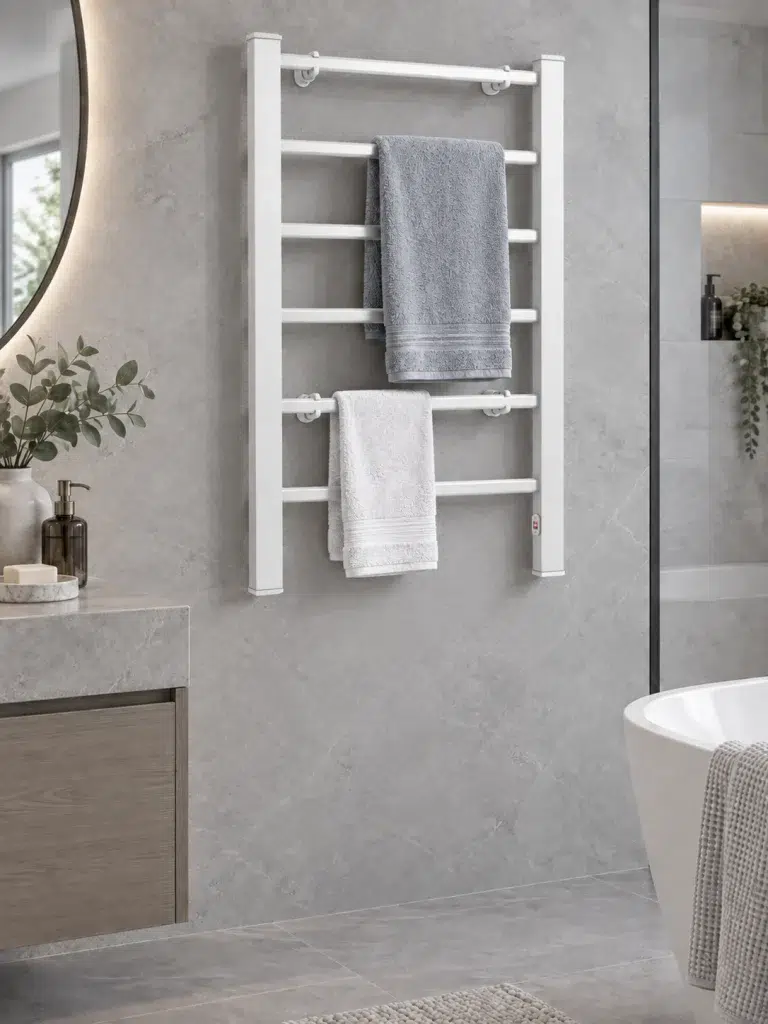
A wall-mounted heated towel rail can suit a compact room with a suitable clear wall. Because it has no floor-standing base, it leaves more room for movement and access beneath the appliance.
However, measure more than the available wall width. Allow for the product’s projection, hanging towels and door movement. Also, follow the clearances in the installation instructions. A narrow wall beside a door may look suitable until you drape a towel over the rail.
You are planning a permanent layout
Wall mounting works well when you already know where you will use the towel warmer. During a renovation, you can plan the mounting position and electrical supply together. As a result, the appliance can fit naturally into the finished room.
However, a fixed position offers less flexibility. Moving the appliance may involve removing fixings, repairing the wall and reviewing the electrical connection. Therefore, choose the location around everyday use as well as appearance.
You have a suitable mounting surface
Tiles, plasterboard and masonry need different fixing methods. The wall and mounting system must support the appliance and its permitted towel load.
For this reason, do not assume that any adhesive hook or generic bracket will work. Some manufacturers offer no-drill accessories. However, you must check the compatible surfaces, load limits and instructions for the exact model and accessory.
When Should You Choose a Freestanding Towel Warmer?
You want to avoid wall fixings
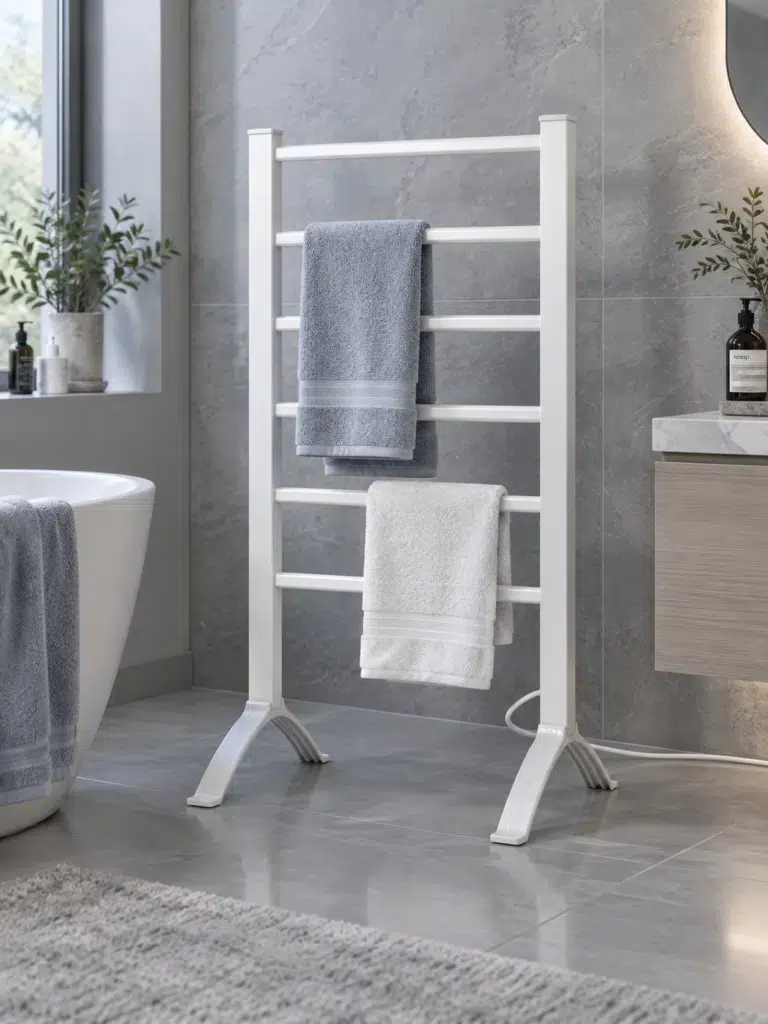
A freestanding electric towel rail can suit customers who want to avoid drilling into a finished wall. Renters may also prefer a model that does not require wall fixings. Fit the correct feet to create a stable alternative to a permanent wall installation.
However, avoiding wall work does not remove electrical requirements. Check that the appliance allows use in your proposed location and that the power supply meets its needs. If a rented home lacks a suitable electrical location, you may need another solution.
Your room layout may change
You can reposition a freestanding towel warmer when furniture arrangements or household needs change, following the manual. It may also suit customers who want to put the appliance away between uses.
First, switch it off and unplug it. Then let it cool and remove the towels before you move it. Follow the manufacturer’s instructions throughout, and never pull the appliance by its cable.
You have enough room for a stable base
The feet form part of the product’s usable footprint. For example, a rack that looks slim from the front may extend further into the room than you expect.
Therefore, measure the full base depth and keep the appliance outside normal walking routes. Use the level surface that the manual specifies. Also, route the cable away from places where someone might pull it or trip over it. Avoid overloading one side or treating the rack as a support handle.
Which Design Warms or Dries Towels Better?
Wall mounting and floor-standing placement do not, on their own, determine towel-warming performance. Instead, compare the actual heating system, rail arrangement and controls of each product.
For everyday results, consider:
- Towel contact: how much fabric touches the heated rails.
- Usable rail space: whether you can arrange towels without excessive overlap.
- Fabric thickness: how a thick bath towel differs from a lightweight hand towel.
- Room conditions: how humidity and ventilation affect moisture removal.
- Operating time: whether you want a short warming session or need to dry a damp towel.
More bars do not automatically mean room for the same number of separate towels. Likewise, higher wattage alone does not establish a fixed drying time. Therefore, compare samples with the same towel load and room conditions when performance drives your buying decision.
Are Wall-Mounted Towel Warmers Cheaper to Run?
Attaching a towel warmer to the wall does not automatically reduce its electricity use. Two appliances drawing the same power for the same time use the same amount of electricity.
For continuous operation at rated power, use this formula:
Energy use (kWh) = power (W) ÷ 1,000 × operating hours
For example, a 100W towel warmer running continuously for four hours uses:
100 ÷ 1,000 × 4 = 0.4 kWh
Multiply 0.4 kWh by your electricity price per kWh to estimate the energy charge. However, a thermostat that cycles the heater or a timer that shortens operation can change actual consumption. Do not assume a particular saving without usage data.
For more worked examples, read our electric towel warmer running cost guide.
Also, separate the purchase cost from the installation cost. A wall-mounted option may involve fixing and electrical work. In contrast, a freestanding option may avoid wall work where a suitable electrical supply already exists. Therefore, compare the complete setup for your room rather than assuming one format always costs less.
Installation and Bathroom Placement: What Matters?
Start with the instructions for the exact product and electrical version. Confirm where the manufacturer allows you to install it, the required clearances and the correct electrical connection. An IP rating covers only part of this assessment. It does not mean you can place the appliance anywhere near water.
For UK installations, Electrical Safety First recommends a registered electrician for electrical installation work. It also warns against using extension leads to bring power into a bathroom without socket-outlets. See its bathroom electrical safety guidance.
However, requirements differ between countries. For other markets, ask a qualified local installer to confirm the appropriate arrangement. Only consider converting a plug-in appliance to a hardwired version if the manufacturer expressly supports that setup. A qualified installer must also carry out the work appropriately.
Can One Towel Warmer Offer Both Installation Options?
Yes—when the manufacturer designs the product for both configurations.
For example, the EVIA EV-100 2-in-1 electric towel warmer supports wall-mounted and freestanding use. This 100W aluminium model has six heating bars. Its listed dimensions show why buyers should compare the complete configurations:
| EV-100 configuration | Width | Depth | Height |
|---|---|---|---|
| Wall-mounted | 520 mm | 100 mm | 800 mm |
| Freestanding | 520 mm | 365 mm | 900 mm |
The wall-mounted dimensions describe the product, not its height above the floor. Therefore, follow the supplied instructions for installation height and clearances.
For a retail range, two installation options can address different customer preferences. However, confirm which feet, brackets and other accessories the quoted package includes. Do not assume that “2-in-1” means every accessory comes as standard. Likewise, do not assume that every towel warmer supports conversion between the two formats.
Which EVIA Design Fits Your Product Range?
EVIA offers several aluminium towel warmer formats for buyers to compare:
| Model | Installation format | Rated power | Rail design |
|---|---|---|---|
| EV-100 | Wall-mounted or freestanding | 100W | Six heating bars |
| EV-190 | Wall-mounted | 190W | Ten flat heating bars |
| EV-200-2 | Wall-mounted | 200W | Twenty oval heating bars |
These formats offer different layouts; the table does not rank their drying performance. Instead, choose around your target customer’s space, preferred appearance and expected towel use. If you are also comparing materials, read our guide to aluminum vs stainless steel heated towel rails.
For wholesale or private-label enquiries, specify the destination market, installation format, power supply, controls, finish and estimated quantity. Also, ask for documentation and accessories that match the exact version you plan to order. Confirm timer, temperature-control or WiFi availability before advertising these functions.
Browse the EVIA electric towel warmer range. Alternatively, use our electric towel warmer buying guide to prepare your shortlist.
Frequently Asked Questions
Which towel warmer is better for a small bathroom?
A wall-mounted design often suits a small room because it leaves the floor beneath clear. However, it still needs a suitable wall, safe electrical placement and enough room for hanging towels. If you have little wall space but a safe floor position, a freestanding model may fit better.
Is a freestanding towel warmer suitable for a rented home?
It can be useful because it avoids wall fixings. However, suitability still depends on the appliance instructions, available electrical supply and intended location. Do not use an extension lead to solve unsuitable bathroom electrical provision.
Does wall-mounted mean hardwired?
No. Wall mounting describes how the appliance attaches to the wall. In contrast, plug-in or hardwired describes its electrical connection. Check the supplied version rather than assuming you can switch between the two connections.
Can a freestanding towel warmer be mounted on the wall?
Only if the manufacturer supports wall mounting for that exact model with the correct accessories. For example, the EVIA EV-100 supports both arrangements. Confirm the ordered configuration and follow the installation instructions.
Does a towel warmer replace bathroom heating or ventilation?
Do not assume it does. Select a towel warmer for its stated towel-care purpose. For whole-room heating, check suitable heat-output information. Also, maintain ventilation to help manage moisture.
Choose Around Your Space and How You Will Use It
For a permanent layout with clear floor space, choose a wall-mounted towel warmer. Alternatively, consider a freestanding design when placement flexibility and avoiding wall fixings matter more. If your customers need a choice of arrangements, evaluate a model that supports both.
Planning a retail, distribution or private-label range? Send EVIA your target market, preferred installation style and expected order quantity. We can then discuss suitable models, samples, packaging and OEM/ODM options.