
Electric Towel Warmer Running Costs: A Practical Guide
These are calculated examples assuming continuous operation at rated power. The tariff is illustrative, not a current UK average or a quoted price cap rate. Your actual electric towel warmer running costs depends on power consumption, operating hours, electricity prices and how the controls work.
This guide explains how to calculate the cost of an electric heated towel rail, compare 100W, 190W and 200W models, and plan a routine that suits your towels and your budget. It covers electric rail-style towel warmers; hot-water rails connected to central heating require a different calculation.
A 100W electric towel warmer costs 2.5p per hour at an electricity rate of £0.25/kWh. A 200W model costs 5p per hour at the same rate. Used for four hours a day, that works out at approximately £3 or £6 per 30-day month.
Request pricing, MOQ and OEM/ODM options →
PARTNER WITH EVIA →
LinkedIn →
How to Calculate Electric Towel Warmer Running Costs
Start with three numbers: the appliance’s wattage, the number of hours it operates, and the electricity unit rate on your bill.
Energy used (kWh) = power (W) ÷ 1,000 × operating hours
Running cost = energy used (kWh) × electricity price per kWh
For a 200W towel warmer running continuously at rated power for four hours:
- Energy used: 200 ÷ 1,000 × 4 = 0.8 kWh.
- Daily cost at £0.25/kWh: 0.8 × £0.25 = £0.20.
- Cost over 30 days: £0.20 × 30 = £6.00.
Use the electricity unit rate, not your total monthly bill divided by an assumed number of hours. In Great Britain, the standing charge is payable even when no energy is used, as explained in Ofgem’s guide to unit rates and standing charges. It is therefore excluded from the incremental appliance costs shown here.
100W vs 190W vs 200W Towel Warmer Running Costs
The following comparison uses £0.25/kWh, continuous rated-power operation and a 30-day month. Monthly and annual figures assume four hours of use every day; annual figures use 365 days.
| Rated power | Energy per hour | Cost per hour | Cost per day 4 hours | Cost per month | Cost per year |
|---|---|---|---|---|---|
| 100W | 0.10 kWh | 2.5p | £0.10 | £3.00 | £36.50 |
| 190W | 0.19 kWh | 4.75p | £0.19 | £5.70 | £69.35 |
| 200W | 0.20 kWh | 5p | £0.20 | £6.00 | £73.00 |
These are arithmetic estimates, not measured consumption tests or guaranteed drying costs. Four hours is a comparison period, not a promise that every towel will dry within that time.
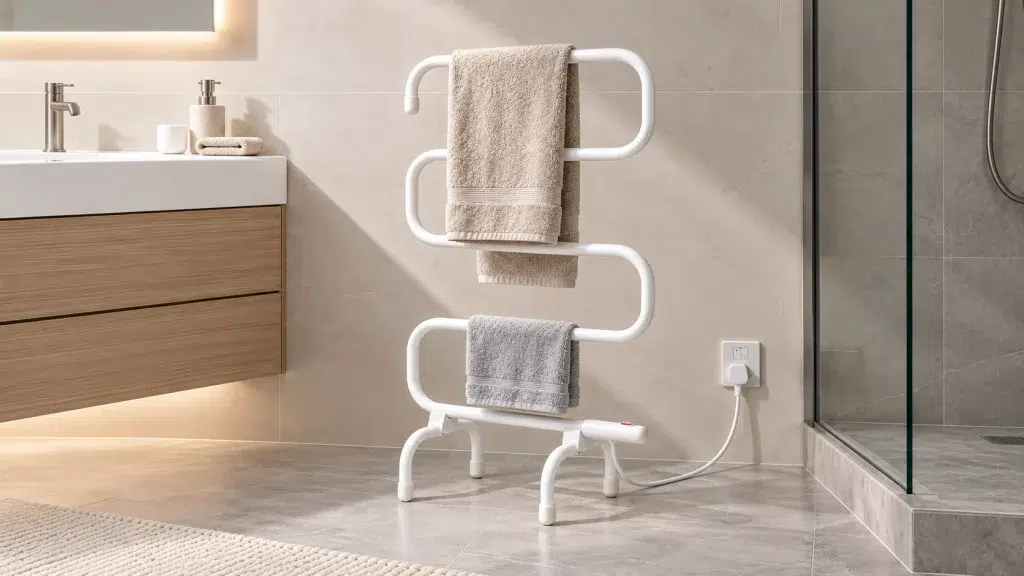
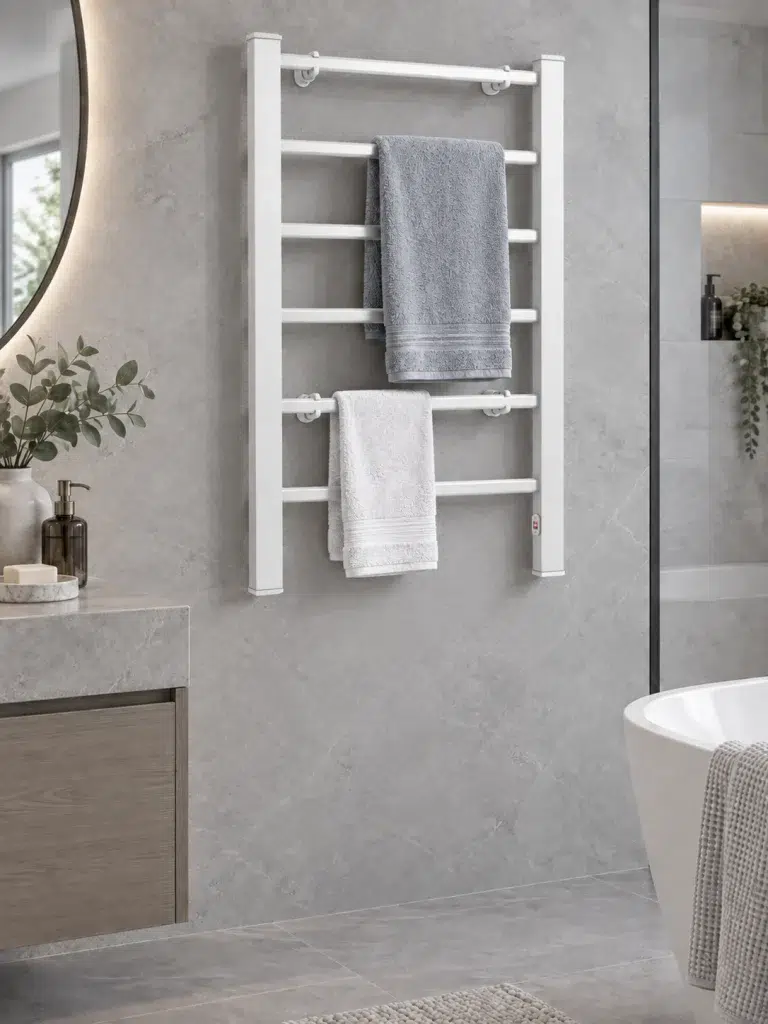
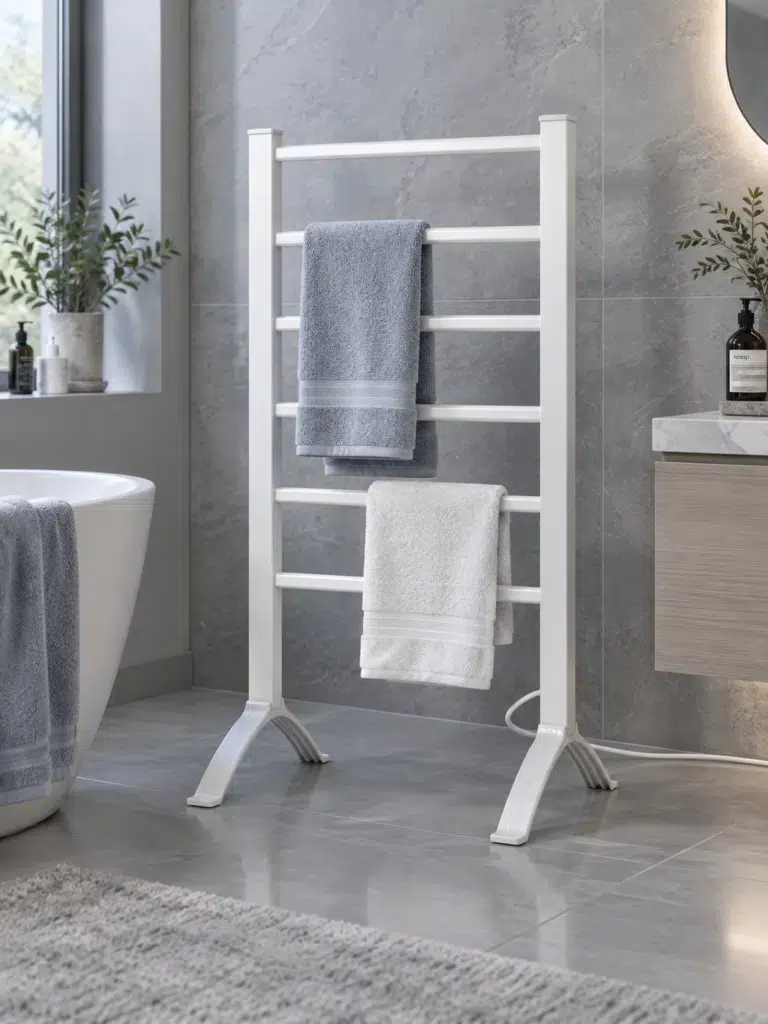
EVIA’s catalogue lists the EV-100 2-in-1 towel warmer at 100W, the EV-190 flat-bar model at 190W, and the EV-200-2 electric towel warmer at 200W. These provide practical examples of different rated powers within a product range.
How Much Does Daily Operating Time Matter?
At a fixed power draw and electricity rate, doubling the operating time doubles the electricity cost. A small hourly cost can still add up when a rail runs all day.
| Hours per day | 100W monthly cost | 200W monthly cost |
|---|---|---|
| 2 hours | £1.50 | £3.00 |
| 4 hours | £3.00 | £6.00 |
| 8 hours | £6.00 | £12.00 |
| 24 hours | £18.00 | £36.00 |
Assumptions: £0.25/kWh, 30 days and continuous rated-power operation. The 24-hour row illustrates cost only; it is not a recommendation for continuous use.
For example, reducing a 200W unit’s operation from eight hours to four hours per day would reduce the calculated monthly cost from £12 to £6 under these assumptions. Whether a shorter session meets your needs depends on towel thickness, starting moisture, arrangement and room conditions.
Use Your Local Electricity Rate
The same formula works in pounds, euros, Australian dollars or any other currency. For a 200W unit operating four hours a day, the calculated energy use is 24 kWh per 30-day month.
| Currency example | Illustrative unit rate | Monthly energy charge |
|---|---|---|
| GBP | £0.25/kWh | £6.00 |
| EUR | €0.30/kWh | €7.20 |
| AUD | A$0.35/kWh | A$8.40 |
These are calculation examples, not national averages, live tariffs or currency conversions. Substitute the applicable rate from your supplier, including relevant taxes in the unit price if you want a tax-inclusive estimate.
If your tariff has different prices at different times, calculate each period separately and add the results. Australia’s regulator-backed Energy Made Easy guide to electricity tariffs explains single-rate, time-of-use and demand tariffs. A simple kWh calculation estimates usage charges; any demand charges need separate consideration.
Why Actual Electricity Use Can Differ
Rated power and thermostat operation
Wattage describes power, while kWh measures energy used over time. A 200W rail drawing 200W continuously uses 0.2 kWh in one hour. A thermostatically controlled model may switch its heater off and on after reaching its target temperature, reducing heater on-time.
Do not assume a fixed thermostat saving. The result depends on the controller, setting, towel load and surroundings. For illustration only, a 200W heater energised for two hours within a four-hour session would use 0.4 kWh for heating, plus any control electronics consumption. This is not an EVIA test result.
Towel load and the result you want
Warming a dry towel before a shower and drying a damp bath towel are different tasks. Thick fabric, tightly folded layers and humid conditions can change the time needed. Compare products using the same towel load and the same desired outcome.
Controls and standby consumption
A timer helps limit operating time. Temperature control adjusts how the heater responds to its target setting. Wi-Fi provides a way to manage compatible controls, but does not itself establish an energy saving. Electronic controls may also consume a small amount of energy while waiting for the next session.
For a more accurate estimate, use measured kWh over a representative routine. Only use a suitable energy monitor where the product connection and location permit it; arrange appropriate measurement for a hardwired appliance.
Does an Aluminium Towel Warmer Costs Less to Run?
Material alone does not determine the bill. Two rails drawing the same power for the same duration consume the same electrical energy, regardless of their outer material. Aluminium can be useful in lightweight product designs, but running-cost comparisons should be based on actual energy use and the drying result.
A lower-wattage model is not automatically cheaper for a complete task. A 100W rail running for eight hours and a 200W rail running for four hours each use 0.8 kWh at continuous rated power. That calculation does not establish that they will dry the same towels equally well.
Our aluminium vs stainless steel heated towel rail comparison explains the wider material considerations.
Request pricing, MOQ and OEM/ODM options →
PARTNER WITH EVIA →
LinkedIn →
How to Keep Electric Towel Warmer Running Costs Under Control
- Choose a useful schedule. Run the rail around your towel routine and adjust the duration after checking the result.
- Use a timer where available. Confirm the functions included with your specific model and version.
- Arrange towels according to the instructions. Avoid unnecessary overlapping that makes the intended drying task harder.
- Allow moisture to leave the room. A heated rail does not collect water like a dehumidifier; normal bathroom ventilation still matters.
- Use the applicable tariff. Moving a session to a cheaper period can reduce cost on a time-of-use plan, even if kWh consumption stays the same.
- Compare a complete routine. Consider capacity and measured energy per task alongside rated wattage.
What Retailers and OEM Buyers Should Ask For
A useful running-cost claim states the wattage, electricity rate, operating duration and calculation method. If a claim comes from testing, document the towel load, ambient conditions, controller settings and measured kWh.
For example, “Calculated cost: 5p per hour at 200W and £0.25/kWh, assuming continuous rated-power operation” is more informative than an unexplained “pennies to run” claim.
When sourcing a range, confirm the supplied control configuration and request model-specific evidence for performance claims. See our electric towel warmer buying guide for the broader selection checklist.
Frequently Asked Questions
Do electric towel warmers use a lot of electricity?
It depends on wattage and operating time. A 100W unit running continuously for four hours uses 0.4 kWh; a 200W unit uses 0.8 kWh. Multiply this by your electricity rate to assess the cost for your household.
How much does a 200W towel warmer costs per month?
At four hours per day, £0.25/kWh and 30 days, it costs £6 for continuous operation at rated power. Actual consumption may differ with controls and conditions.
Is a timer worth having?
A timer can help avoid unwanted operating hours. The saving depends on how much running time it removes from your existing routine; it is not a fixed percentage.
Can I leave a heated towel rail on all day?
Follow the instructions for the exact model. If continuous use is permitted, calculate its cost before choosing that routine. A 200W rail drawing rated power for 24 hours uses 4.8 kWh, costing £1.20 at the illustrative rate of £0.25/kWh.
Does quick heat-up mean my towel will dry in five minutes?
No. Surface warm-up and towel drying are different measurements. Drying time depends on the towel, moisture content, arrangement and room conditions.
Choose a Towel Warmer for Your Product Range
Explore EVIA’s electric towel warmers to compare formats and rated powers. For OEM and private-label enquiries, share your target market, preferred dimensions, finish, controls and estimated quantity.