
Plug-In vs Hardwired Heated Towel Rails: A Buyer’s Guide
When comparing plug-in vs hardwired heated towel rails, the main difference is how they connect to the electricity supply. A plug-in model uses a suitable socket, while a hardwired model connects to a fixed electrical supply. Choose the connection based on the installation location, available power supply and product instructions. Wall-mounted and freestanding describe a separate feature: how the appliance stands or attaches to a wall.
A towel warmer may look right for a room yet require an electrical arrangement the buyer has not planned for. For retailers and importers, an unclear connection description can also cause buyers to order the wrong product.
This guide compares electric rail-style towel warmers, also called electric heated towel rails. It covers connection options, their relationship to mounting styles, ownership costs and the details to confirm before ordering. It does not cover water-filled radiators that connect to central heating systems.
Request Specifications & a Quote →
Plug-In vs Hardwired Heated Towel Rails at a Glance
| Buying question | Plug-in towel rail | Hardwired towel rail |
|---|---|---|
| How does it receive power? | Through its supplied plug and a suitable socket | Through an approved fixed electrical connection |
| What must be available? | A permitted socket location within the supplied cable’s reach | A suitable fixed supply and an appropriate connection arrangement |
| What installation work might you need? | Mounting or fitting feet; electrical work if a suitable socket is absent | Mounting plus professional electrical connection; possible wall work |
| Will a cable be visible? | Usually some cable remains visible | Concealed routing may be possible, depending on the design and installation |
| Is it easy to relocate? | Depends on the mounting style and another suitable power location | Relocation requires reassessing the fixed connection |
| Is it cheaper to run? | Actual consumption and operating time determine the cost | Actual consumption and operating time determine the cost |
| What should a buyer confirm? | Plug type, voltage, cable length and permitted placement | Wiring entry, supply requirements, compatible controls and installation instructions |
Use this comparison to shortlist a configuration. The instructions for the exact appliance and local electrical requirements determine whether it suits the intended location.
What Is a Plug-In Heated Towel Rail?
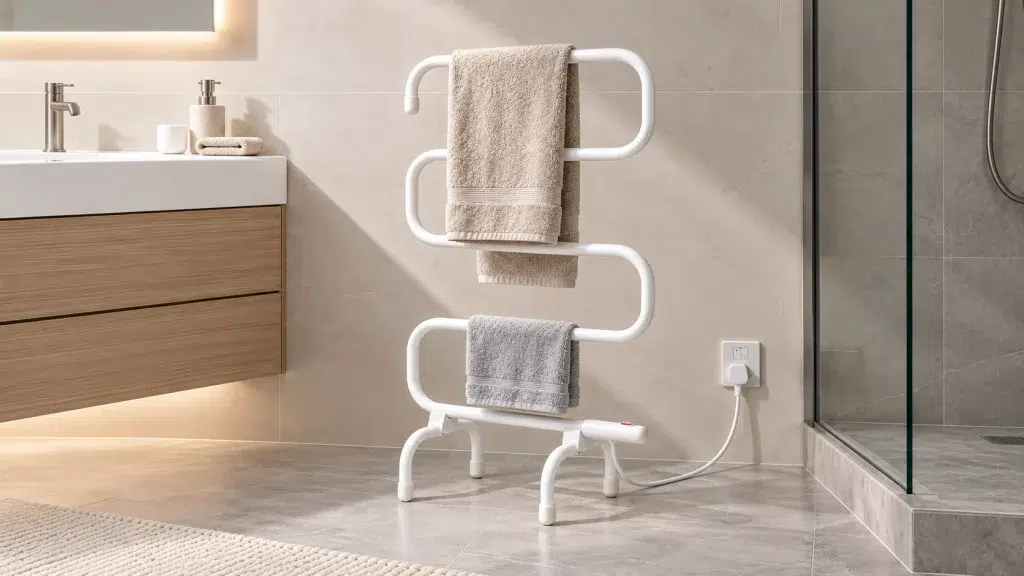
A plug-in heated towel rail comes with a power cord and plug. It may suit a room that already has an appropriate socket, provided the manufacturer permits that use and location.
Its main buying advantage is a straightforward connection where the electrical provision is already suitable. However, “plug-in” does not mean “no installation required”. A wall-mounted model still needs secure mounting, and you may need to fit the supplied feet to a floor-standing model.
Before choosing a plug-in version, check:
- The appliance voltage and frequency match the destination supply.
- The supplied plug is appropriate for the market.
- The cable reaches the permitted socket position without tension.
- You can route the cable clear of walking routes and other hazards.
- The manual permits the intended room and placement.
For a retail listing, show the supplied connection clearly. A product photo that hides the cable should not leave customers guessing about how the unit receives power.

What Is a Hardwired Heated Towel Rail?
A hardwired towel rail connects to a fixed electrical supply through the connection arrangement the manufacturer specifies for that product. It can suit a planned installation where the buyer and installer consider the mounting location and supply route together.
Concealed cable routing can create a tidy appearance, but this depends on the appliance design and the building. Hardwired does not automatically mean that every cable or connection point will be invisible.
Plan this option before finishing a renovation where possible. Ask the installer to review the connection location, isolation, suitable controls and access for future servicing. The cost may include more than connecting the appliance: wall preparation and making good can affect the total.
A professional electrical connection is part of the purchasing plan. This article is a selection guide, not a wiring tutorial.
Does Wall-Mounted Mean Hardwired?
No. Mounting style and power connection are separate specifications. Manufacturers may offer wall-mounted towel warmers in plug-in or hardwired versions. Freestanding models often come with a plug, but buyers should still check the exact configuration the manufacturer approves.
| Configuration | Main reason to consider it | Key purchasing check |
|---|---|---|
| Wall-mounted + plug-in | Clear floor space with an accessible plug connection | Wall fixings, cable route and permitted socket position |
| Wall-mounted + hardwired | A permanent installation with planned electrical routing | Supported fixed connection and installer requirements |
| Freestanding + plug-in | Placement flexibility without wall fixings | Complete base footprint, stability and suitable power location |
| Convertible mounting design | One model supporting more than one mounting arrangement | Manufacturer approval and the accessories supplied |
For example, the EVIA EV-100 2-in-1 electric towel warmer supports wall-mounted and freestanding arrangements. That description refers to mounting flexibility; it does not establish approval for both plug-in and hardwired electrical connections.
For a fuller comparison of floor space, positioning and mounting, read Wall-Mounted vs Freestanding Towel Warmers: Which Design Should You Choose?.
Which Connection Suits Your Buying Situation?
An existing room with a suitable socket
Consider a plug-in version when the product instructions and local requirements permit that location and the supplied cable reaches the socket correctly. Compare the full setup, including wall brackets or feet, rather than assuming the plug removes every installation task.
A renovation with a fixed layout
Consider an approved hardwired model when you and your installer can plan the electrical supply alongside the mounting position. Confirm the model before the installer prepares the connection: wiring entry positions and fitting dimensions can differ.
A rented home or changing layout
A freestanding plug-in model may reduce the need for wall alterations. It still needs enough floor space and a permitted power location. Moving it later depends on the manual, including switching off, unplugging and allowing it to cool.
A retail or private-label range
Start with how customers will install and use the product. A range intended for straightforward setup needs clear cable, plug and mounting information. A renovation-focused range needs usable drawings and precise electrical requirements.
Keep separate configuration codes where products differ electrically. Similar-looking versions should not share ambiguous packaging, installation instructions or marketplace specifications.
Planning a towel warmer range? Ask EVIA to review your target market and required configuration. Include your preferred mounting style and electrical connection so the EVIA team can check suitability before preparing a quotation.
Are Hardwired Towel Rails Cheaper to Run?
Hardwiring alone does not lower the energy required by a heater. For equivalent appliances drawing the same power over the same period, the electricity consumption is the same regardless of the connection method.
For continuous operation at rated power:
Energy use (kWh) = rated power (W) ÷ 1,000 × hours used
For example, a 150W appliance operating continuously for three hours uses 0.45 kWh. At an illustrative electricity price of £0.30 per kWh, the energy charge is £0.135, or 13.5p.
This is an arithmetic example, not an EVIA model specification, measured test or current electricity tariff. Controls that cycle the heater can change actual consumption. A timer can limit operating hours if it suits the appliance and you use it appropriately.
Compare three costs separately:
- Purchase cost: the appliance, accessories and chosen controls.
- Installation cost: mounting, electrical work and any wall repairs.
- Operating cost: actual energy use multiplied by the electricity unit rate.
See our electric towel warmer running cost guide for further examples. Neither the connection type nor mounting style is enough to establish a drying time or an energy-saving percentage.
What Should You Check Before Bathroom Installation?
Confirm the intended placement against the exact product instructions and the requirements in the destination market. An IP rating is one part of the assessment; it does not authorise every position near water.
For UK installations, Electrical Safety First’s bathroom safety guidance advises using a registered electrician for electrical installation work and warns against bringing power into a bathroom with extension leads where there are no socket-outlets.
For other countries, use the applicable local requirements and a suitably qualified installer. Do not transfer a UK example directly to an Australian, European or other installation.
Buyers should obtain the instructions before finalising the product location. For volume orders, also check that the documents, labels and electrical version refer to the same supplied configuration.
Request Specifications & a Quote →

What Should Wholesale and OEM Buyers Specify?
A clear enquiry gives the supplier enough information to discuss a suitable product and identify what still needs confirmation.
| Specification | What to provide or request |
|---|---|
| Destination | Country of sale and intended sales channel |
| Electrical version | Voltage, frequency and requested plug-in or hardwired arrangement |
| Mounting | Wall-mounted, freestanding or a supported convertible design |
| Product envelope | Available space, preferred dimensions and towel capacity requirements |
| Controls | Required on/off, timer or temperature-control functions; confirm availability |
| Appearance | Material, finish and branding requirements |
| Documentation | Model-specific instructions and applicable compliance documentation |
| Packaging | Required feet, brackets, fixings, labels and retail carton contents |
| Commercial details | Estimated quantity, sample needs and delivery schedule |
For a mounting-flexible option, EVIA lists the EV-100 as a 100W aluminium model with six heating tubes. Ask the supplier to list the accessories and electrical configuration in the quotation. If your project requires a hardwired connection, request written confirmation of availability and suitability before specifying it.
Avoid treating optional controls or safety functions as standard. The approved sample, product specification, instructions and retail claims should describe the same version.
For broader selection criteria, use our electric towel warmer buying guide.
Frequently Asked Questions
Can you convert a plug-in towel rail to hardwired?
Only consider conversion where the manufacturer expressly supports it for the exact model and supplies the relevant instructions. Do not assume that removing a plug creates an approved hardwired appliance. Ask a qualified professional to carry out any electrical work that the manufacturer supports, following the relevant instructions and local requirements.
Are all wall-mounted towel warmers hardwired?
No. Wall mounting describes how the product attaches to a wall. Plug-in and hardwired describe how it receives electricity. Confirm both specifications when comparing products.
Is a plug-in towel warmer easier to install?
It can be simpler where a suitable socket already exists. You may still need mounting work. The product instructions and local requirements must also permit the room and electrical position. If you need a new electrical supply point, include that work in the comparison.
Does hardwired mean faster heating?
No. Connection type alone does not establish heating speed. Compare the heater design, rated power, controls and relevant performance information for each model under comparable conditions.
Does a 2-in-1 towel warmer offer both electrical connections?
Not necessarily. The term may refer to wall-mounted and freestanding arrangements. Ask the supplier to define exactly what “2-in-1” includes and confirm the electrical version separately.
Request the Right Towel Warmer Configuration
Choosing between plug-in vs hardwired heated towel rails starts with your available power supply and installation plan. Next, select the mounting style that suits the room and your customers’ needs. For wholesale and OEM orders, confirm both specifications before requesting a quotation.
Sourcing aluminium towel warmers for retail, distribution or a private-label project? Send EVIA your destination market, preferred mounting style, required electrical connection and estimated quantity. Ask for suitable model specifications, sample options and a quotation.