
Electric Towel Warmer Safety Standards: What Global Buyers Should Check
Before ordering an electric towel warmer, verify the destination market, applicable safety standards, exact model configuration, electrical protection, IP rating and installation instructions. Ask for traceable test evidence and the required declarations or listings. A logo on a brochure cannot establish that the product you receive is suitable for your market.
For importers, retailers and private-label brands, safety review belongs before sample approval and bulk production. Discovering that a controller, plug or rating label falls outside the documented configuration can delay a launch and create avoidable rework.
This guide focuses on electric heated towel rails and racks. Bucket-style warmers, spa cabinets, hydronic rails and appliances marketed for additional functions need their own classification review. The market overview below covers common EVIA buyer destinations; it is not an exhaustive worldwide approval list.
Start with EVIA’s electric towel warmer range if you are comparing product formats alongside compliance requirements.
Which Safety Standard Applies to Electric Towel Rails?
IEC 60335-2-43:2024 addresses household and similar electric clothes dryers and towel rails within its scope. It is used with the relevant general requirements of IEC 60335-1.
An international standard is a technical reference, not a worldwide sales permit. Buyers should have the laboratory or certification body confirm the destination’s accepted national adoption, edition, amendments and deviations. The latest IEC publication is not automatically the edition currently recognized in every market.
Ask the supplier: “Which standards and editions were used for this exact model, and how do they support sale in our destination country?” Record the answer against the quoted SKU.
Electric Towel Warmer Compliance by Market
| Destination | What buyers should review | Evidence to request |
|---|---|---|
| European Union / EEA | Applicable CE legislation, including LVD for equipment within its voltage scope, RoHS and applicable EMC requirements; accepted EN standards | Signed EU Declaration of Conformity, supporting reports, model identification, rating label and instructions |
| Great Britain | Electrical Equipment (Safety) Regulations and other applicable legislation; the chosen CE or UKCA compliance route | Declaration and technical evidence matching the route, plus required manufacturer/importer information |
| Northern Ireland | Applicable EU product rules and NI-specific marking arrangements | Confirmation of the correct route; do not assume GB arrangements apply unchanged |
| United States | Product classification, applicable safety standard, installation code, retailer and authority requirements | Verifiable listing where required, correct US scope, electrical ratings and approved installation instructions |
| Canada | Canadian certification requirements and applicable provincial/territorial rules | A certification mark and listing valid for Canada, covering the exact model |
| Australia | State/territory requirements, applicable AS/NZS standards, EESS scope and risk classification, and relevant RCM obligations | Classification confirmation, safety evidence, responsible-supplier details and registration/certification where required |
| New Zealand | Local electrical safety obligations and applicable declared-article requirements | Local supplier evidence, and SDoC or approval where required for the classification |
EU: Check the Declaration Behind the CE Mark
CE marking is the manufacturer’s declaration of conformity with applicable EU requirements. It does not, by itself, mean an independent certification body has approved the appliance.
For mains-powered products within its scope, review the Low Voltage Directive. Confirm the relevant harmonised standards and their status, rather than assuming that a standard number alone proves conformity.
Electronic controls require an applicability review under the EMC framework. RoHS concerns restricted substances; a RoHS report does not establish electrical or thermal safety. Wireless versions need a separate review of applicable radio-equipment requirements.
Great Britain: Avoid Outdated UKCA Assumptions
Current UK government electrical-equipment guidance recognizes qualifying CE-marked electrical equipment in Great Britain alongside the UKCA route. Do not assume every shipment must carry both marks. Establish the route, supporting declaration and local economic-operator obligations before artwork approval. Northern Ireland has different arrangements.
North America: Verify the Listing and Its Country Scope
UL and ETL marks should lead to verifiable certification records. ETL is a certification mark, not the name of the technical standard used to evaluate a towel warmer. Intertek explains its ETL Listed Mark and provides an official directory.
Check whether the record covers the US, Canada or both, and whether it identifies the actual model and construction. Have the certification body determine the applicable standard and edition for the design. CE documentation is not a substitute for required North American approval. Equally, a component approval does not establish a finished-appliance listing.
Australia and New Zealand: Confirm Classification Separately
Do not automatically classify a heated towel rail as a Level 3 clothes dryer. The EESS equipment definitions specifically exclude heated towel rails from that clothes-dryer definition. This exclusion does not establish the complete compliance route for every towel-warmer design.
Ask the Australian responsible supplier or certification body to confirm classification, applicable standards and obligations before ordering. Consult EESS risk-level guidance and check requirements for the destination jurisdiction. For New Zealand, separately review WorkSafe’s electrical safety requirements; do not assume Australian paperwork alone resolves local obligations.
What Does IPX4 Mean for a Towel Warmer?
IPX4 describes protection against splashing water under specified test conditions. It does not mean the appliance is suitable for immersion or unrestricted exposure to water jets. The “X” means that this designation does not specify a solid-particle protection rating. See the IEC IP ratings guide.
An IP rating also does not approve every bathroom location. Buyers need to check the complete appliance, connection arrangement, permitted installation position and manufacturer’s instructions against local wiring rules. A switch advertised as waterproof does not establish the IP rating of the assembled towel rail.
For example, Electrical Safety First’s UK bathroom guidance highlights RCD protection and restrictions on socket placement. Other countries have their own installation requirements. Fixed electrical work should be handled by a suitably qualified installer as required locally.
For a closer comparison of connection methods, read plug-in vs hardwired heated towel rails.

Seven Checks Before Approving a Production Sample
The following is a procurement checklist, not a replacement for the testing required by the applicable standard.
1. Match the Electrical Configuration
Compare the purchase specification, rating label and reports for voltage, frequency, wattage, plug, cable and connection type. A travel adaptor does not convert a product into a different certified market configuration. Ask how each regional variant is identified and controlled in production.
2. Confirm Protection Against Electric Shock
Establish the appliance’s protection class and the evidence supporting its construction. For an earthed design, ask about protective-earth verification. For a double-insulated design, confirm that the documented construction supports the classification. Frame material alone does not answer this question.
3. Review Temperature and Abnormal-Operation Evidence
Ask which temperature measurements and abnormal-operation assessments appear in the model’s report. Request clarification on what happens under the fault conditions relevant to the design. A controller setpoint is not automatically the temperature of every accessible surface, and a low wattage alone does not prove safety.
4. Separate Convenience Controls from Safety Protection
A timer controls operating duration. A thermostat regulates temperature. Neither label alone demonstrates the complete protective system. Ask the supplier to explain the design and its supporting evidence, including any claimed overheat protection. Our timer and temperature-control guide explains the purchasing considerations for these features.
5. Check Mounting, Stability and Cable Routing
Review the approved mounting method, hardware, wall requirements and clearances. For freestanding products, evaluate stability under the intended loading conditions. Check that cable routing avoids pinching, strain and foreseeable contact with unsuitable surfaces. For a two-in-one model, establish which configurations the evidence covers.
6. Read the Label and Manual Together
Confirm consistency between the model reference, electrical ratings, safety markings, installation instructions and packaging. Review required languages and traceability information. Instructions should explain intended towel loading, cleaning and use restrictions without contradicting the product page.
7. Control Changes After Approval
Agree on a signed specification and controlled sample. Require review before changes to heating components, controls, wiring, seals or other safety-relevant parts. Even a visually similar substitution may need assessment. Ask how the supplier records routine production checks and traces finished units to a batch.
Documents to Request Before a Bulk Order
Use this checklist during supplier qualification. The required document set depends on the destination and compliance route.
| Document or record | Buyer’s verification question |
|---|---|
| Product specification and rating-label artwork | Does it identify the exact quoted model and electrical variant? |
| Declaration of conformity, where applicable | Is it signed, traceable and aligned with the model and legislation? |
| Safety test report or appropriately reviewable evidence | Does it cover the construction, standard edition and relevant market deviations? |
| Certification/listing record, where required or claimed | Can the issuer confirm the model, scope and current status? |
| IP test evidence, where an IP rating is claimed | Does it cover the complete assembly and intended configuration? |
| Installation and user manual | Are connection method, limits, warnings and required languages clear? |
| Relevant EMC and material-compliance evidence | Does the evidence match the controls and supplied materials? |
| Production-control and change records | How is the approved construction maintained after sampling? |
If a full report contains confidential information, agree on an appropriate review process rather than accepting a certificate image as the only evidence.
Planning a retail or private-label range? Ask EVIA about available model-specific compliance documents. Include your destination country, installation type and preferred electrical configuration.
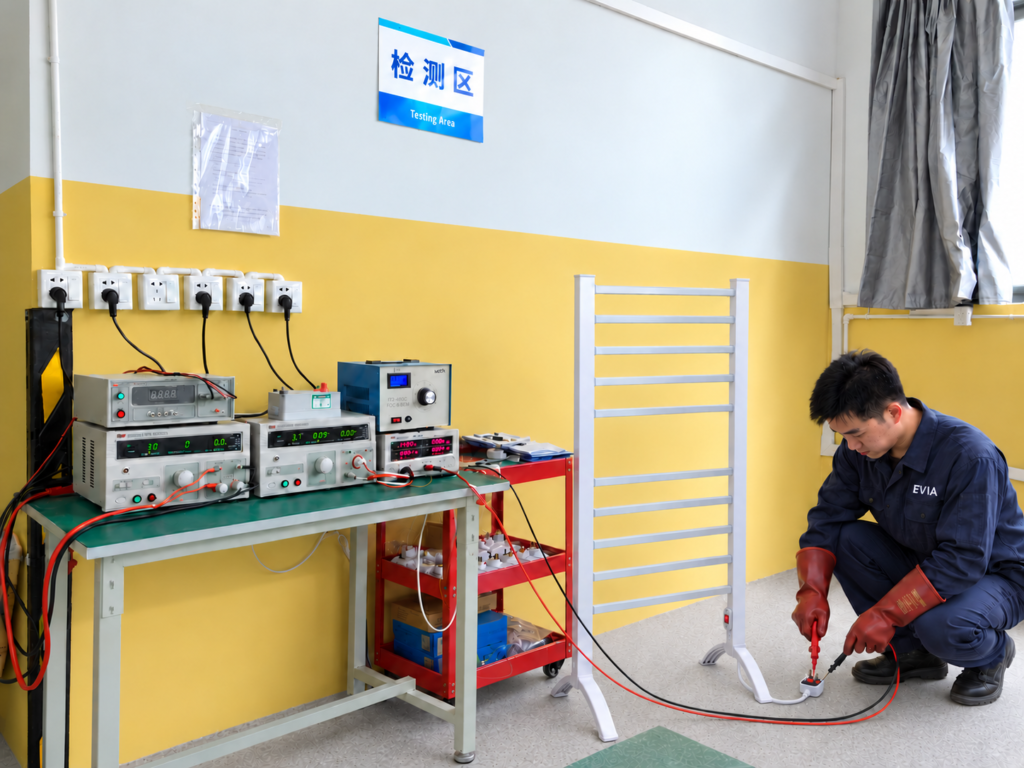
Supplier Red Flags Worth Resolving Early
Pause approval when a document names a different model, an issuer cannot verify a claimed listing, or the sample’s plug and controller differ from the documented version. Other warning signs include blanket “certified worldwide” claims, IP claims without supporting evidence, and changes introduced after approval without review.
Factory management certificates and social audits can support supplier evaluation, but they do not replace product-level safety evidence. Likewise, a successful commercial sample does not establish conformity with every applicable requirement.
Frequently Asked Questions
Does a CE mark prove independent certification?
No. CE marking communicates the manufacturer’s declaration of conformity with applicable EU requirements. Review the declaration and supporting technical evidence for the exact model; do not infer third-party approval from the mark alone.
Is an IPX4 towel warmer suitable anywhere in a bathroom?
No. IPX4 is a splash-protection classification, not permission for unrestricted installation. The product’s instructions, connection method and local electrical rules determine where it may be installed.
Can one towel-warmer certificate cover every country?
Do not assume so. Destination standards, national differences, ratings, marks and importer obligations vary. Confirm coverage of each intended market and each supplied variant.
Does an automatic timer replace overheat protection?
No. Operating-time control and protective behavior serve different purposes. Check the complete design and relevant test evidence instead of relying on a feature name.
What should an importer send with a compliance enquiry?
Send the destination country, selected model or format, voltage and frequency, plug-in or hardwired requirement, controller features and expected order quantity. This helps the supplier identify the relevant configuration and any further assessment needed.
Discuss Your Target-Market Requirements with EVIA
EVIA supplies heated drying products for retail, distribution and private-label programs. Explore EVIA’s manufacturing background and use the electric towel warmer buying guide to refine your product shortlist.
For your next enquiry, tell us where the product will be sold, how it will be installed, your preferred control features and expected order quantity. Ask about available compliance evidence for the selected model, sample options, MOQ and quotation details. Final specifications and document coverage should be confirmed for the agreed configuration.
Request a Target-Market Towel Warmer Quote
Sources checked: 14 October 2026. This buyer guide supports procurement planning; it is not a certificate, exhaustive legal checklist or installation instruction. Verify the applicable requirements for the actual product and destination before placing it on the market.